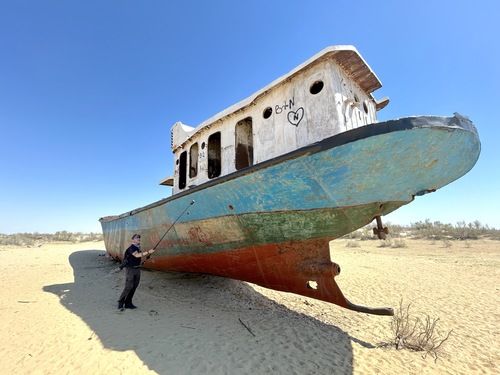
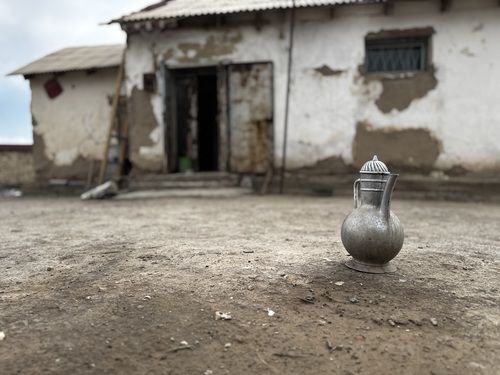
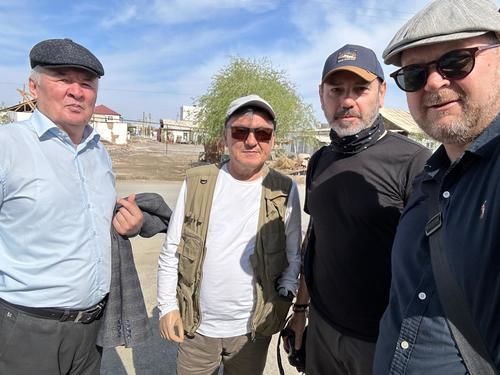
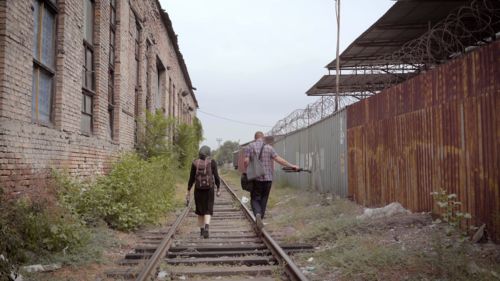
This time, the Gulag.cz research team went to Uzbekistan, specifically to its autonomous Republic of Karakalpakstan situated in the west of the country (where you can also find the Aral Sea, which is currently drying out). During the first half of April 2026, the expedition team members explored the physical remnants of an uncompleted Gulag project from the early 1950s, the Main Turkmen Canal in the town of Takhiatash located near the Karakalpak capital of Nukus. This is where the expedition’s working title came from: tracking the ‘Dead Canal’. Following expeditions to Kazakhstan and Kyrgyzstan, this is the third destination in Central Asia at which Gulag.cz conducts its research. We started focusing on this region after expeditions to the Russian Federation ceased to be feasible due to the war in Ukraine and the Russian authorities’ pressure against explorations in the field of Soviet repressions. During our expedition, we located one of the camps and thoroughly documented its only surviving barrack as well as the remnants of other structures and the canal itself. We also recorded a testimony of a witness who had remembered a detailed description of the former camp for almost 50 years without telling anyone until our arrival.
During our expedition, we located one of the camps and thoroughly documented its only surviving barrack as well as the remnants of other structures and the canal itself. We also recorded a testimony of a witness who had remembered a detailed description of the former camp for almost 50 years without telling anyone until our arrival.
Thanks to our expedition, we can now declare with authority that physical remnants of Gulag camps exist also in Uzbekistan even though this fact has never been mentioned in literature, press or on the Internet. Thus, we can now add yet another major geographic dimension, effectively expanding our understanding of the Soviet labour camps and living conditions in them.
We are happy to claim that this is a first on the part of Gulag.cz. With this being said, it would not be possible without the help of our local partners, the Karakalpak Academy of Sciences and the Nukus branch of the Museum of Victims of Political Repression in Uzbekistan.



From the initial idea to the expedition
Štěpán Černoušek came up with the idea of exploring the remnants of the Main Turkmen Canal in September 2025. While on a trip to Central Asia, he went to Nukus for two days, hoping to find out whether any physical remnants of any Gulag project could be found there. “I thought, something must have survived from those times. When you want to find out but no literature is available to read about it, you just have to go to the location. This is how the Expedition ‘Dead Canal’ came to be,” explains the chair of Gulag.cz.
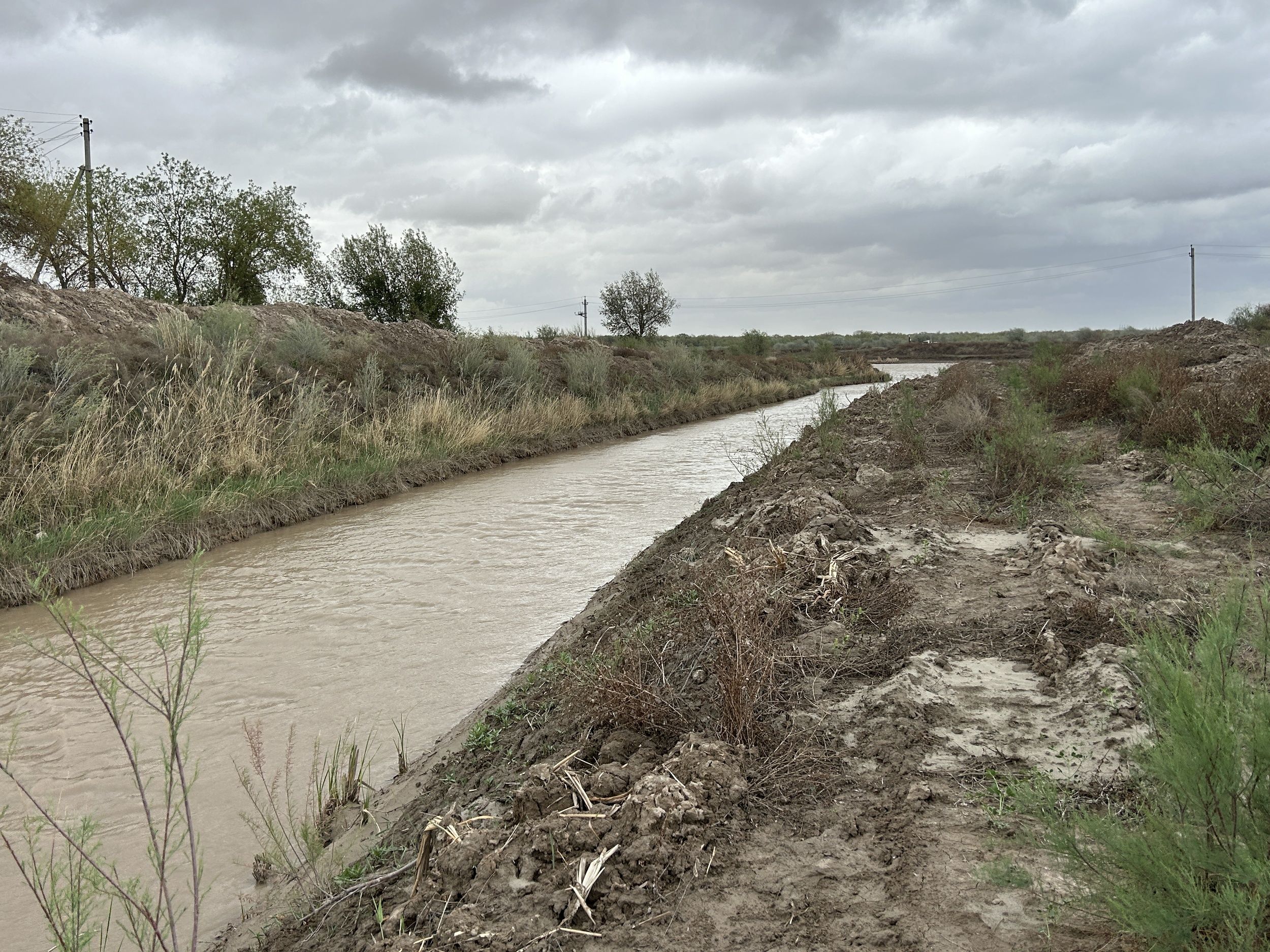
In Takhiatash where the canal project launched in 1951, he found out from the locals that, indeed, there were visible remnants of the canal that was abandoned unfinished as well as the barracks of a prison camp, currently in use as residential buildings slated for upcoming demolition. He arranged with the local historians to conduct quick rescue research for documentation purposes. This was the objective of the Expedition ‘Dead Canal’.
Chair of Gulag.cz Štěpán Černoušek in collaboration with Roman Smýkal documented the historical sites. The Czechs partnered with the local historians Askar Dzhumashev from the Karakalpak Academy of Sciences and Alisher Kudiyarov from the Nukus branch of the Museum of Victims of Political Repression.


A history of the Main Turkmen Canal
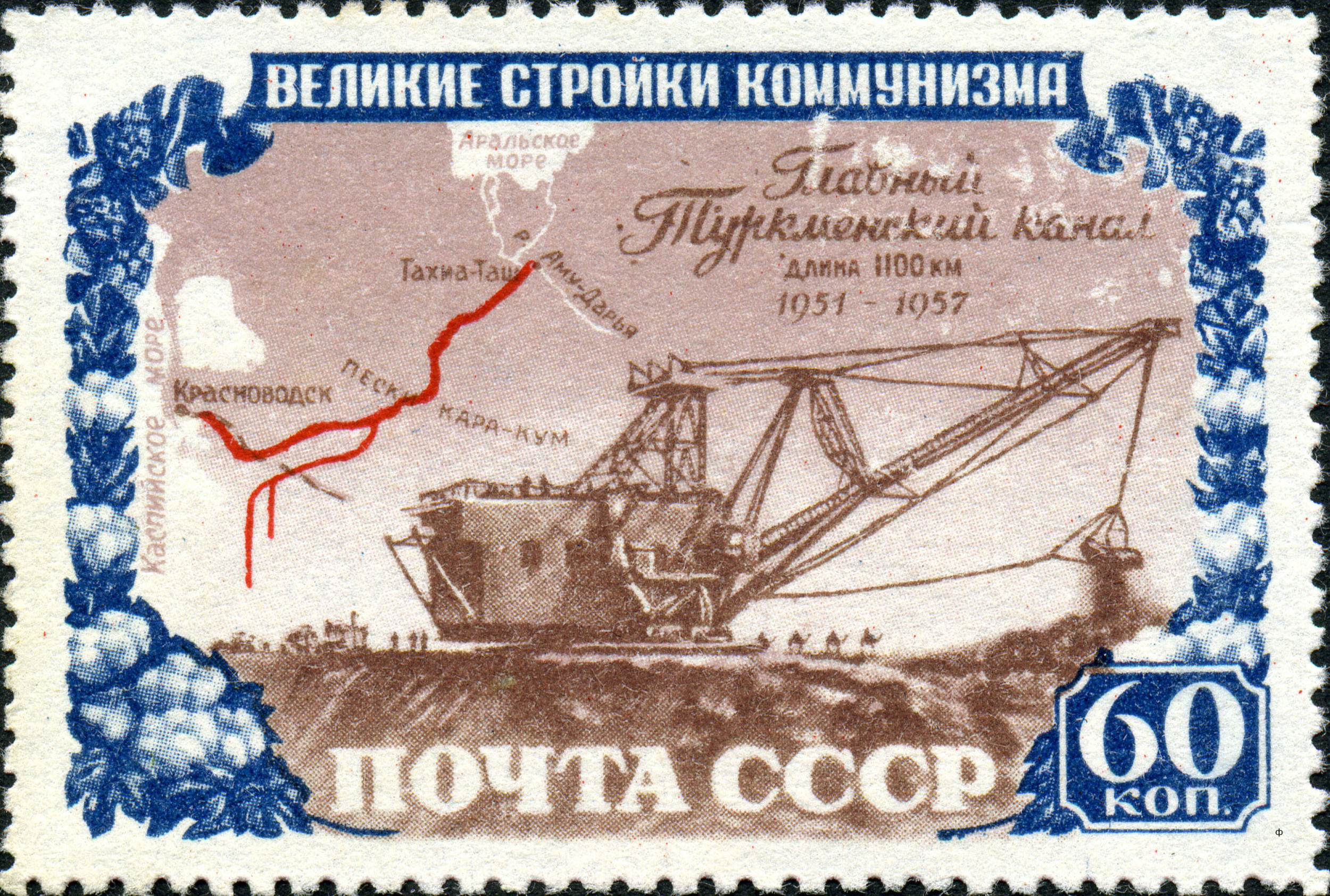
One of the most ambitious projects under the “Great Plan for the Transformation of Nature” and a “Great Construction Project of Communism”, the Main Turkmen Canal received the green light from the Soviet government in 1950. It was planned to be more than 1,100 kilometres long and its purpose was to bring water from the Amu Darya through the Karakum Desert all the way to the Caspian Sea, effectively providing a new transport route connecting the Aral Sea, the Caspian Sea and Moscow while opening millions of hectares of new farmland for growing cotton. The brunt of the work involved in it was imposed on Gulag prisoners – in fact, a dedicated camp system – Karakumlag – was set up for this purpose.
The canal was meant to be the second longest in the world. It was supposed to stretch more than 1,100 kilometres from Cape Takhiatash on the left bank of the Amu Darya (12 km south of Nukus in today’s Uzbek Karakalpakstan) all the way to Krasnovodsk (today’s Turkmenbashi) on the Caspian Sea shore. The vast majority of the canal was outlined on the territory of today’s Turkmenistan, utilising the dried-out bed of the River Uzboy for most of its length.
Further to the Resolution of the Council of Ministers of the USSR No. 3906 of 11 September 1950 (the wording of which a colleague of ours has just found in the State Archive of the Russian Federation in Moscow), the canal was designed to include a system of dams, locks, reservoirs, three hydropower plants with a total capacity of 100,000 kW, and bypass canals and piping of more than 1,000 km in length. A massive dam combined with a hydropower plant was to be built near the Takhiatash end of the canal. In total, 25 per cent of the Amu Darya flow was to be diverted to the new canal; the level of the Aral Sea was to be lowered; and the soil thus exposed was intended for farming. The canal was meant to be more than 100 metres wide and 6 to 7 metres deep. The plans envisaged using thousands of trucks, bulldozers and excavators, but the prisoners dug the first seven kilometres of the canal – all that has survived from the entire project – by hand, using the most primitive of tools and equipment in extreme desert weather conditions. The project was to be completed by 1957.
Project progress
In December 1950, a settlement was founded near Cape Takhiatash on the left bank of the Amu Darya where there used to be just two sheds for the burlaks (workers who pulled cargo barges up the river) and the barges. Within the settlement, two prison camps were built for 1,500 prisoners; the plan was to deploy a total of 6,000 prisoners by the end of 1951.
Massive shipments began arriving in Takhiatash from all over the Soviet Union. The country virtually lived on the propaganda that celebrated the big project of communism. Based on witness accounts, project governance was extremely poor, with large amounts of the goods and material being stolen, left unsecured, and/or rendered unusable due to poor storage.
Several camps and utility infrastructure facilities were built in 1951. The Chardzhou–Khodzheili railway with a branch line to Takhiatash was opened on 15 June 1952 to facilitate future supplies. Infrastructure for the project was built and research expeditions were organised. The number of workers involved in the project is estimated at 10,000, with more than half of them being prisoners.



Abandonment of the canal
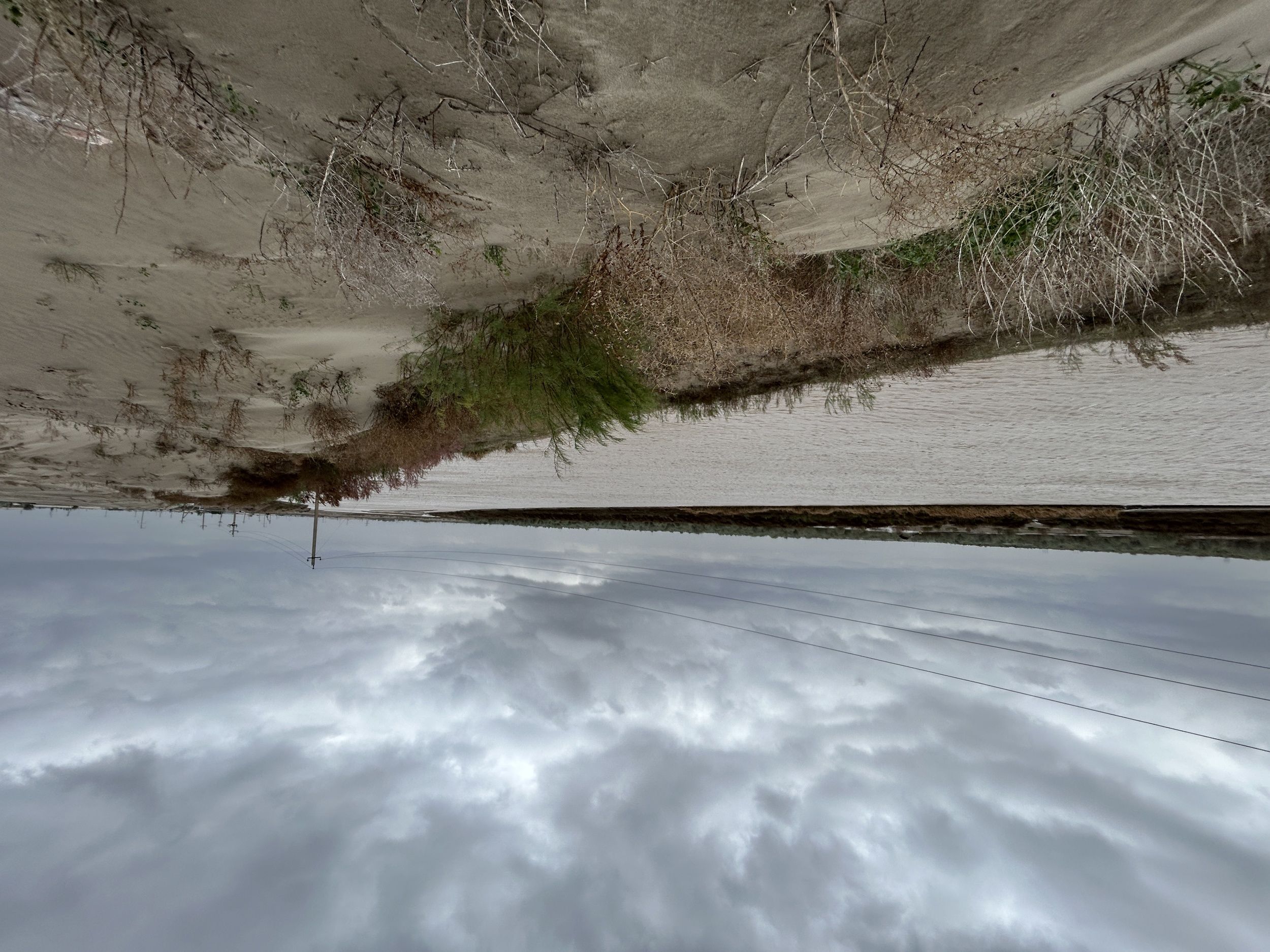
The project stopped just as quickly as it had begun. Lavrentiy Beriya halted the project right after Stalin’s death in March 1953 because it was uneconomical and poorly designed. Most sections under construction were abandoned and prisoners were released from the camps or relocated. By then, the prisoners had built dozens of kilometres of new railway lines, the few initial kilometres of the canal itself, and infrastructure for the town of Takhiatash. All of this happened on the territory of today’s autonomous Republic of Karakalpakstan – the project never progressed to the territory of Turkmenistan.
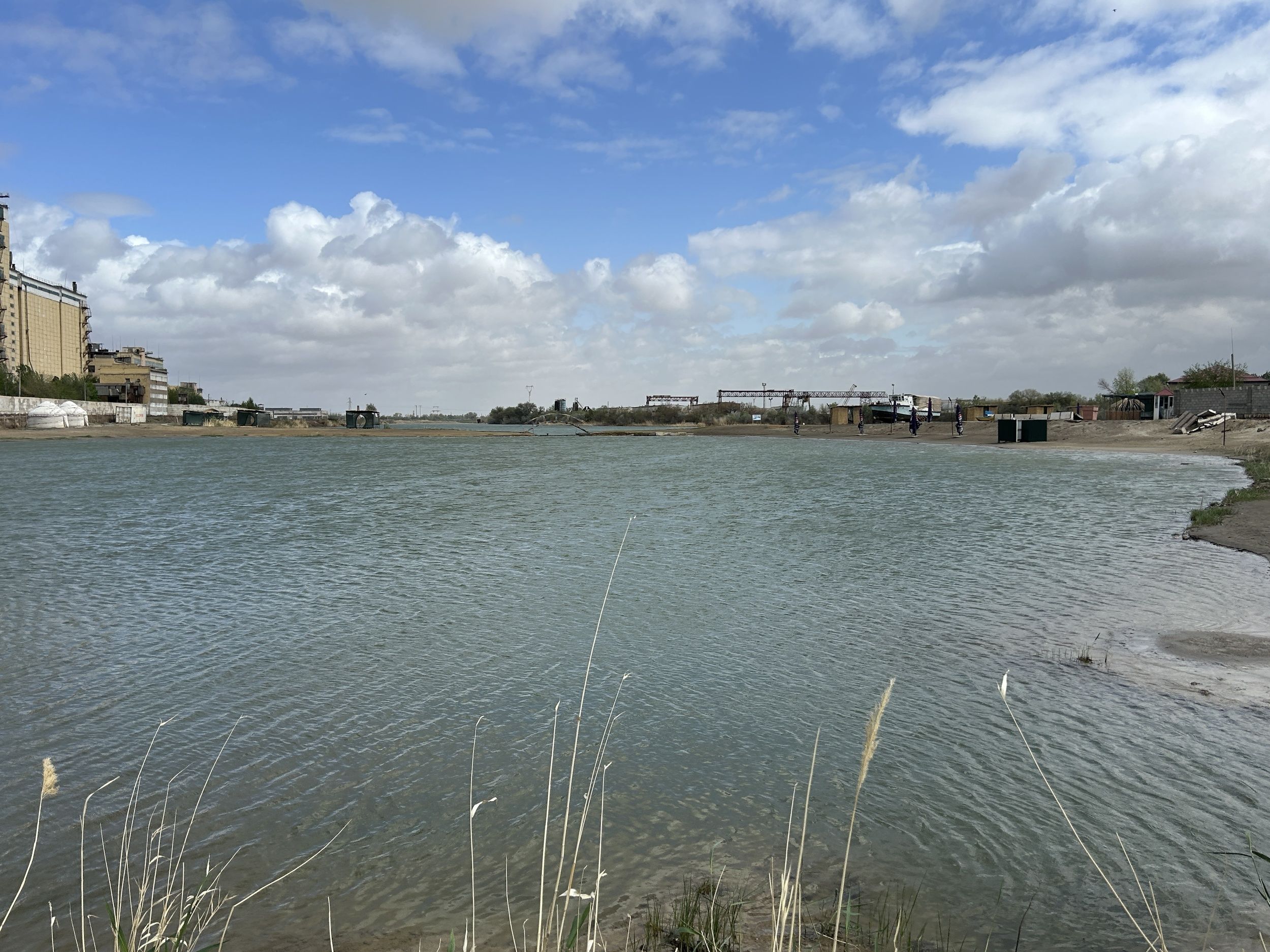
Later on, the construction of the Karakum Canal was launched on the opposite side of the Turkmen Soviet Socialist Republic in 1954. Fully completed in 1988, it is 1,300 km long and supplies water to a large part of Turkmenistan territory to this day. In the meantime, other irrigation canals were built in Karakalpakstan and Northern Turkmenistan, in effect rendering a gigantic canal stretching from Takhiatash to the Caspian Sea unnecessary. As a result, the initial northern part of the Main Turkmen Canal remains an unfinished torso and a symbol for the Stalinist megalomania to the present day. Our Expedition ‘Dead Canal’ focused on the remnants of the project in the town of Takhiatash.



The expedition
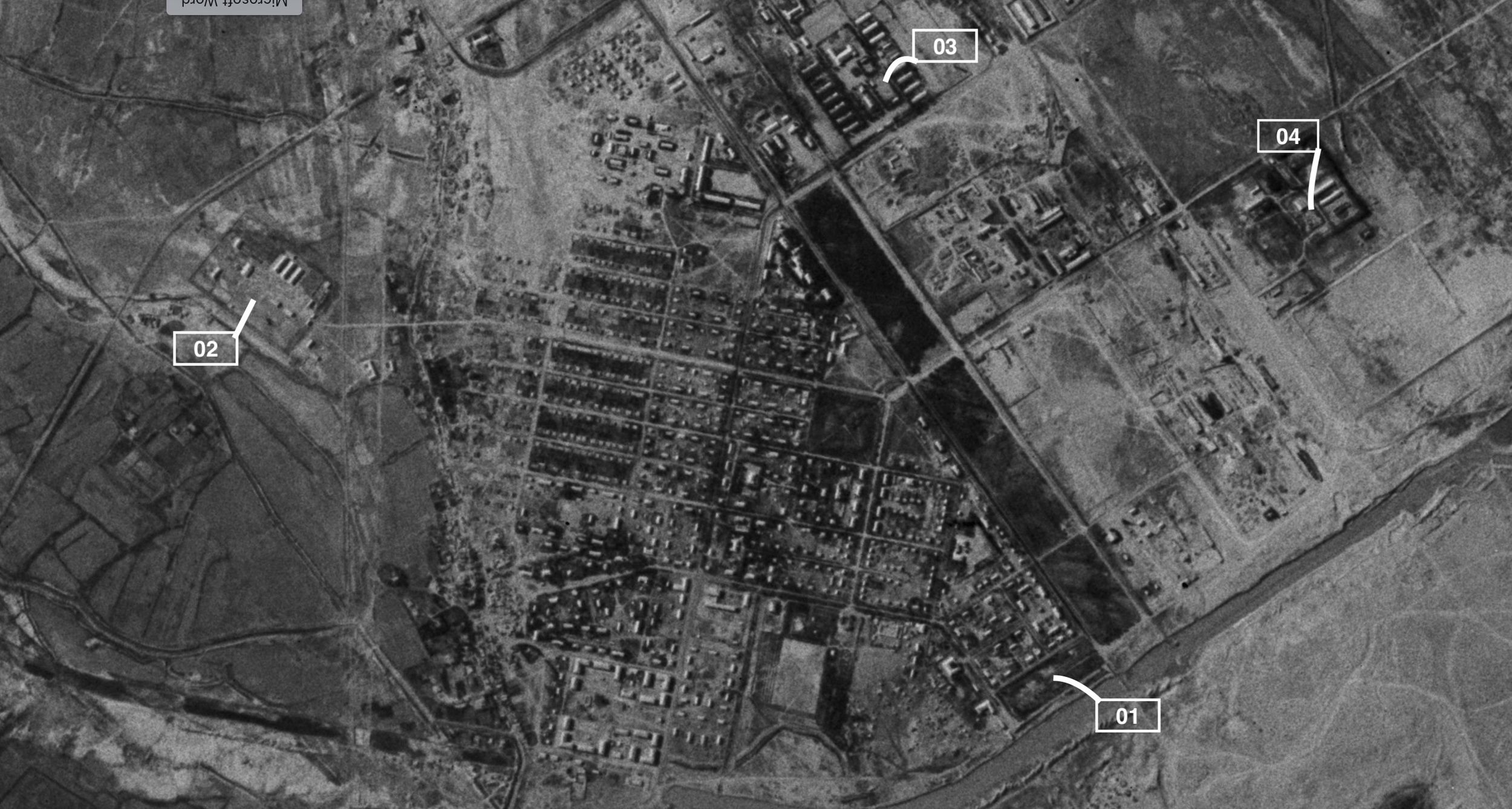
The journey towards documenting the surviving canal remnants and locating the labour camp precisely was not easy. We could not have undertaken it without the declassified CIA satellite espionage photographs from 1962 that we obtained in advance. They show that the location we initially believed to have been the camp grounds (since the local citizens referred to it as such during the brief initial visit to Takhiatash in September 2025) was not developed in 1962 yet, and thus it could not have been the camp grounds at the time the Main Turkmen Canal was being built. Accordingly, we focused on other locations that, based on the satellite imagery from the early 1960, resembled camps as we know them from our previous travels to the Dead Road and Kazakhstan. We identified three of such locations. Close inspection during site visits revealed that two of those had been altered so thoroughly during more than 70 years of the town’s evolution that nothing original could be identified there.
The third location had remained relatively intact. There used to be an electrical engineering school from the late 1960s on, and its campus comprised large areas of unused land. This land is actually where the camp once used to be.
Mr Kalmurat speaks
Former school guard Mr Kalmurat Urazov confirmed to us that the site actually used to be a Gulag camp. He and his sons are the only people to inhabit the former school campus which has been abandoned since 2009. They live in a small house that, at a glance, dates back to the 1950s, and Mr Kalmurat confirms that this is the only structure of the former camp to survive in its entirety. It used to be a guard house next to the camp gateway. This is where the guards checked all the comers and prodded the trucks’ cargo areas with poles to detect any fugitive prisoners. The building housed a fast-food establishment during the school era.
Mr Kalmurat attended the school sometime back in the 1980s. More importantly, his father used to work in the camp as a stoker in the early 1950s. Being a hired worker, he was not in contact with the prisoners very much. However, he described to his son in minute detail the barracks in the camp, the things he had seen, and the conditions under which the prisoners lived. As a young boy, Kalmurat used to go play football on a pitch newly made on the former camp grounds, and his father was not happy about this. He felt that an area where so many people had suffered was not a good place for children to play, and so he duly explained to Kalmurat what he had seen and what he remembered.
Kalmurat remembered it all very well – but he never told anyone until our arrival. We were the first people to whom he related detailed information about the camp he had heard from his father almost 50 years ago. He said nobody was interested in it in the past; neither his school mates nor their teachers knew the place’s history, and he felt no urge to tell them. Maybe he was even a little scared; and there was nobody who cared later on.
Even our local historian colleagues, town hall employees and many other people we met in Takhiatash had no idea at all about prison camps from the Stalin era. Everything seemed to be long covered by history’s dust, or rather by the salt from the nearby dried-up Aral Sea. Yet, Mr Kalmurat was in position on the day of our visit, as if he had been waiting for us.


The story of the place comes alive
We know at this point that the three oblong structures visible in the old satellite photos were actually the prison barracks. We know where the solitary confinement section was and that it involved 12 cells for individuals, each with a tiny barred window; we know where the food storage and dining room was; we know where the changing and disinfecting rooms were; we know how big the roll call area was and where the watchtowers, workshops, the gate and the guard house were. We have verified all of this based on Mr Kalmurat’s recollections, both old and current satellite images, the remnants of walls and foundations (which have survived for almost every camp building), and also from our experience with previous expeditions.
For example, we can see that the location of the solitary confinement section relative to the other barracks followed a strict rule across the USSR whereas the size of the barracks and of the camp as a whole or the position of other structures did not follow any set format. This camp zone was relatively large (measuring 270 by 190 metres) and held an estimated 500 to 700 prisoners. As it happens, this is approximately 10 per cent of the total number of the prisoners who worked on the Main Turkmen Canal project according to archive documents. This means that there is still quite a lot to be discovered and clarified; there is no doubt that there were other camps in the area as well. We have so much material and documents that we will be able to reconstruct the layout of the camp at least in the virtual realm.
Mr Kalmurat (who is of Uzbek nationality) also told us that the local prisoners included many Poles, Ukrainians, Belarusians, and Russians sent over from other camps in the Siberia. This type of information is virtually unavailable from any archives that have been declassified thus far. Also, we do not know of any memoirs written by any prisoners who worked on the Main Turkmen Canal. This makes Mr Kalmurat’s testimony all the more valuable. German prisoners of war also worked there, and some of the former convicts stayed to live in Takhiatash after Stalin’s death. Among them was at least one German, a Mr Schmidt who Mr Kalmurat remembers showing him wartime photos when he was a child. It is also worth mentioning that Mr Kalmurat’s father fought in the ranks of the Red Army while liberating Prague. As a reward, he got the stoker job in the labour camp’s boiler house… He did not live in the camp, coming to work there every day, as did the kitchen staff, and only Mr Kalmurat moved in there some 20 years ago.
Before that, he went to school that was there, and in the 1990s, as he recalls, he was among those who took apart most of the barracks that were still standing at the time. Times were rough, so people broke the unused buildings apart in search for any metal objects they could sell. When they dismantled the solitary confinement barrack, five grown men reportedly struggled carrying the massive steel door of each cell. They took everything they could to the scrapyard. Luckily, one building was spared – the former guard house, Mr Kalmurat’s current dwelling. It is a typical prison camp structure made of adobe bricks on a concrete foundation, with roof made of fibre cement and straw mixed with clay for insulation.


Preserving memory
Our explorations were greeted with support on the part of the local government; the hakim (Mayor) of Takhiatash took personal interest in our search, and so besides the discovery in itself, we also went home with a promise that the place will not be forgotten – in fact, they are ready to embark on a shared project of memorialising the former camp. Uzbekistan in general takes no issue commemorating the Soviet repressions and crimes; after all, the museum of repression victims has branches all over the country including Karakalpakststan. The difference is that they perceive this topic in terms of remembering the suffering of specific people – the executed Basmachi (the local rebels who fought the Soviets in the 1920s and 1930s), Uzbeks, and Karakalpaks, but they almost never memorialise specific sites as such – this is not customary. In addition, there were much fewer Gulag camps there in comparison with, say, Kazakhstan, and the local people were not their prisoners. This is why this topic and the entire ‘Dead Canal’ project were completely forgotten.
We will be happy if our expedition causes the topic of the Gulag to receive somewhat more attention in Uzbekistan. Russia is currently attempting to delete this part of its history by eliminating Memorial organisations and the Gulag Museum in Moscow. That makes keeping this memory alive somewhere else all the more important – whether it be in our country, Central Asia, or Uzbekistan… It can be anywhere, really. In addition, this is a topic that ties us closer to these parts of the world more than we might believe.
The future output of our expedition will be an elaborate rendering of our documentary work including detailed drawings, 3D models, and detailed information regarding the history of the Main Turkmen Canal construction project and the current state of its remnants. All of this and more will be coming soon in our virtual museum, Gulag Online.
Written by Štěpán Černoušek, 23 April 2026